

See if you can spot the problem with the following statements.
Wealthy Person: “It’s in my self-interest to maximize my wealth, so that’s what I’m going to do.”
Wealth Inequality Activist: “You’re only serving your self-interest by maximizing your wealth, and I want to stop you.”
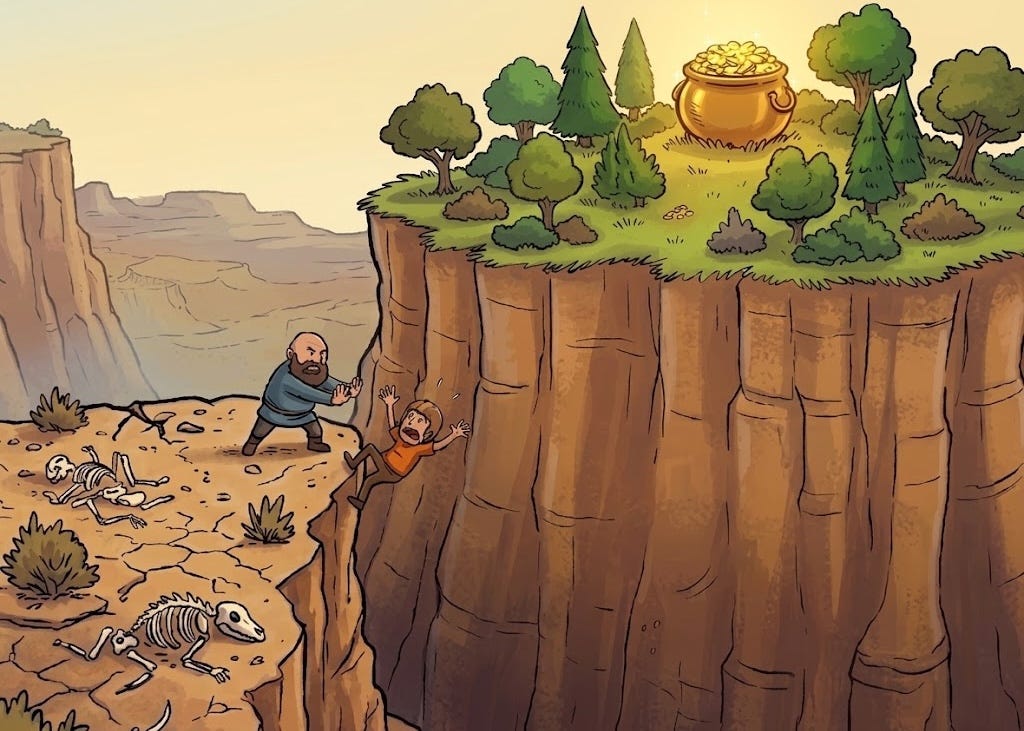
One of my frustrations with the debate around wealth inequality is that both sides accept the conceit that endless wealth accumulation is the optimal path for the wealthy. This presents two problems. The first is that it’s factually incorrect—more on that in a moment—and the second is that it frames the debate as zero-sum: if the wealthy are winning by maximizing wealth, then to do anything else must mean they’re losing.
This is all very counterproductive. It’s nearly impossible to get people to harm themselves for your benefit, just as it’s trivially easy to get them to help you if they believe doing so also helps them. Yet the wealth inequality debate misses this and doggedly adheres to zero-sum thinking. Both sides agree that the wealthy currently occupy the best territory, with the wealthy fighting to hold it—by opposing higher taxes, for example—and activists trying to push them off it.
But what if there’s an oasis hiding in plain sight, one that increases the well-being of wealthy and non-wealthy alike? And what if activists could lead the wealthy to it? Now, instead of trying to strong-arm someone stronger than them, they get their desired outcome without using any force at all.
This is possible.
In my book, A Solution to Wealth Inequality, I propose three types of arguments one can make to persuade the ultra wealthy toward voluntary generosity.
Altruism: Wealthy people can live happier and more fulfilling lives by using their money to help others. Altruism isn’t a drag and doesn’t have to come at the expense of fun. It can be genuinely enjoyable.
Fear: It’s a historical fact that societies become unstable at a certain level of inequality, and American inequality is now comparable to that of France on the eve of the French Revolution. Billionaires are the undisputed winners of this society, the one we live in right now, and have a greater interest than anyone in preserving it.
Redirection: People maximize wealth trying to chase the same highs they got from building their fortune, despite severely diminishing returns as net worth climbs. Generosity can deliver recognition, visceral enjoyment, and the feeling of accomplishment as well or better than growing wealth, while also benefiting society.
The common theme across all three is that wealthy people can improve their own lives, not just other people’s, by embracing generosity. You will not find a single sentence in my book along the lines of, “Okay wealthy people, time to take one for the team and open that pocketbook.” No. It simply isn’t true that wealthy people need to sacrifice to solve this problem, and the faster people absorb this truth, the sooner we will see real change.
If you want to learn more, you guessed it… buy my book.
(Speaking of which, my 1990s TV-brain can’t use that phrase without thinking of this…)