

To any Gen Zs who may have stumbled upon my Substack, put down your vape and get a load of this: did you know that Amazon was originally a bookstore?
Shocking, I know, but it’s true. Quick history lesson: Amazon started with books because they were the ideal product to sell on the nascent internet of the early 1990s. Here’s why.
Books are a commodity. Things like clothing and produce have individual variation, which means people like to examine them before buying, but a book is a book is a book. You know what you’re getting without having to see it first.
No brick-and-mortar store could stock the millions of books that are in print. This meant that right out of the gate, Amazon had an edge over the competition because they could sell virtually any book.
Amazon was able to use existing wholesale book distributors instead of having to warehouse books and fulfill orders themselves, drastically reducing complexity and the capital needed to start the business.
Books are cheap, non-fragile, and don’t spoil. Perfect for shipping.
Given that books are where Amazon got its start, you might think they're still an important part of the business. You’d be wrong. In 2025, books accounted for less than 4% of Amazon’s revenues. That’s partly a function of how much their other businesses have grown and partly because people don’t read anymore (fantastic article).
This lack of importance to Amazon’s overall business is evident in their offerings to authors and publishers. In my noble quest to sell my book, A Solution to Wealth Inequality, I’ve been repeatedly flummoxed by how bad many of Amazon’s tools are. For a company with a market cap of $3 trillion, you’d think they could hire a few developers to fix products that are badly designed, buggy, or just plain broken. But apparently they can’t.
Number One on the list is Amazon Ads, which is somehow the third largest advertising business in the world (!!!).
Want your ad approved? Google and Facebook will do it pretty much instantly, but I’ve had Amazon take as long as three days to approve an 8-word text ad.
What about creating and testing multiple ads? Nope, you can only run one at a time, and it’s surprisingly difficult to see your own ad in the UI (it’s hidden under Campaign Settings).
Want to add more placements after you’ve set your campaign live? Too bad, that feature is broken. You’ll just get a lot of error messages if you try.
How about tracking? Conversion pixels1 have been standard in digital advertising for 20 years, but Amazon doesn’t support them. This means my Google ad spend is basically wasted, since I can’t see which keywords and ads are generating sales.
Amazon’s self-publishing platform, Kindle Direct Publishing (KDP), is also surprisingly sparse. There’s no app or mobile site, limited reporting, and very little in the way of customer support. Stats are laggy and reviews sometimes don’t submit or take several days to appear.
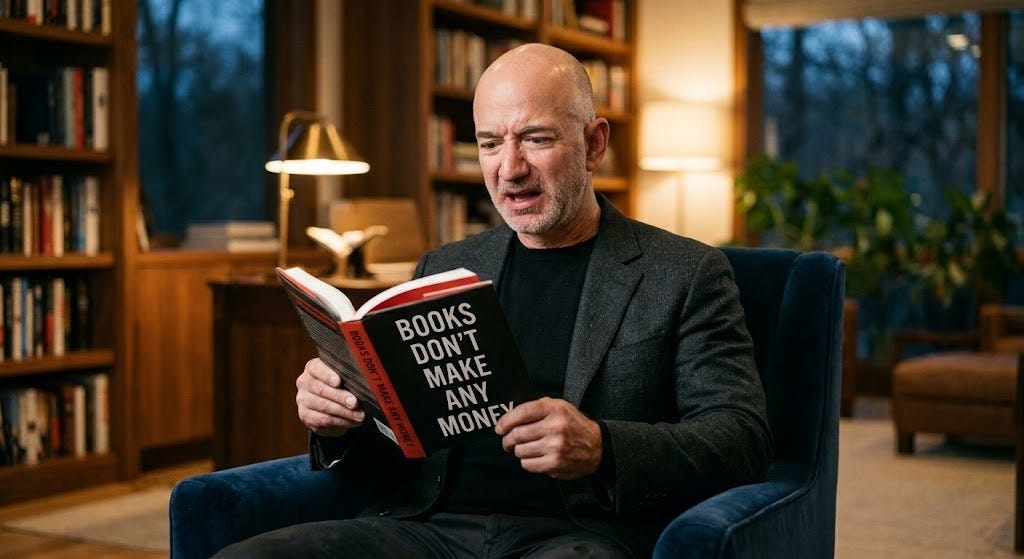
I could go on, but let’s be honest: this post peaked with a disgusted Jeff Bezos reading a book called Books Don’t Make Any Money. Time to wrap things up on a positive note.
Gripes aside, it truly is remarkable what Amazon has done with KDP. In another era, I would have had to spend a year begging publishers for a book deal, and then if I was lucky enough to get one, I’d spend another year waiting for them to release it. With KDP, there are no gatekeepers and you can get your book listed on the largest bookstore in the world in a few minutes. Major hat-tip to Amazon here.
While it’s true that many self-published books are awful, there have also been some pretty good ones, like Fifty Shades of Gray, The Martian, and Rich Dad Poor Dad. Also, as I noted in my last post, self-publishing is the only game in town for many authors. Unless you’re the reincarnation of Ernest Hemingway, or you’re a 99th percentile networker, or you’re already famous from doing something else, it’s nearly impossible to get a book deal with a respectable publisher in 2026.
So Amazon it will have to be, warts and all. (But please, for the love of god, add support for conversion pixels.)
If you like my work, please share it!
Every new voice helps to spread the conversation faster. Please share this newsletter with anyone who might be interested. Thank you!
A conversion pixel is a snippet of code used to capture data about an online purchase or sign-up. For example, it can tell you which ads and keywords are generating sales, and which are not.